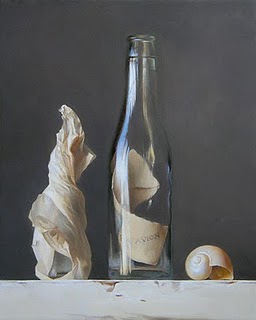
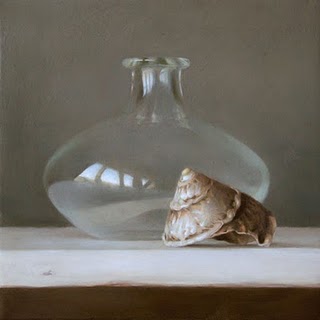
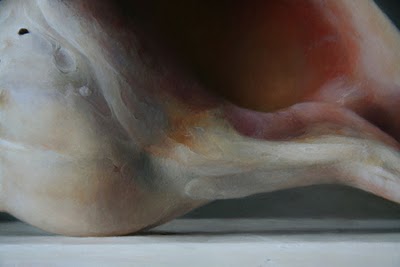
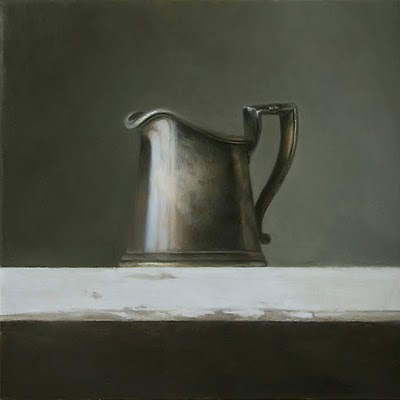
Sterling Boat - DETAIL - work in progress
oil on panel

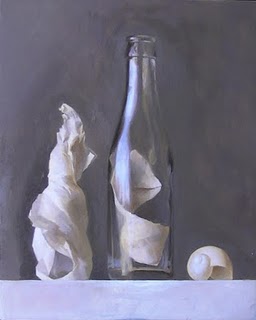
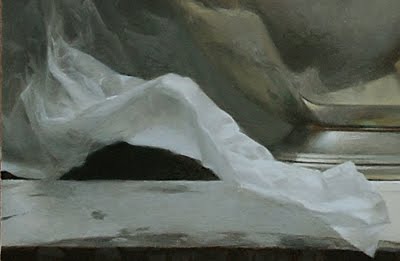
Sterling Boat - PREVIOUS DETAIL
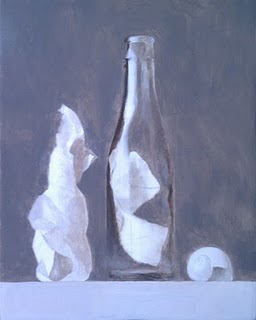
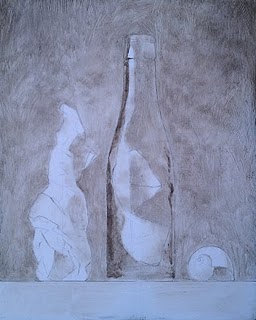
The painting is coming down to the final stages, I'm hoping to be done in just a few more sessions. This is the stage of the painting when it gets hard to record the difference with a camera. I'm sorry to say the differences between the two above shots represents a solid 6 hours of work! The refinement is subtle but significant in real life, but almost impossible to see by the time the camera has degraded the images.
I was listening to one of my favorite podcasts today called "On the Media", and they were talking about the evolution of the book (OTM Episode: Book 2.0) now that we are crossing over into a digital era for reading. They interviewed writers and book publishers and future-thinkers who all had opinions, ranging from "it's not a book unless it has paper and glue and survives being dipped in the bathtub" to "the age of paper is dead and everyone will be reading in an entirely different way in 5 years."
One of the future-embracers was positing that the way writers WRITE will change in the new era, and floated his vision of a writer writing a novel live, online, with a real-time audience who will be intimately involved in the writing process, and that the whole process of creating a book with be collaborative and public. To which I though AAACK!!!
The interviewer suggested that many writers feel that solitude while working is integral to the process, and that some writers would not WANT to write if it had to be a public, collaborative process. The book-futurist (sorry I don't have his name, I don't take notes on my audio sources, unlike my husband who wisely documents everything he hears) said something to the point of "well, writers will just have to change they way they think about writing".
Writers will just have to change they way they think about writing. Wha????
As a an artist, I am probably on the leading edge of those who feel comfortable being public with my process - between my blog posts, my videos, and my teaching I try to make my process as transparent as possible, mostly for my own benefit of processing what I am learning, but also because some of you out there seem to enjoy seeing the thoughts behind the work. And yet, if I were forced to both share my process and allowed my visitors to comment on my decisions in real-time as I made them, and also modify my painting as the comments poured in, I would probably put down the brush and find something else to do!
I might be the extreme though, in that I shy away from collaboration, but some artists are more open to it. Personally, I need to be handled very carefully when I am in "work mode", as anyone who worked with me as a graphic designer can attest, I am not at all a "team player" when I am trying to be creative!
What do other artists think? Could you work with an audience? Even performing artists - could the musician practice with an interactive audience, could the actor rehearse with an interactive audience? Does it sound like a nightmare to you, or does it sound like a revolutionary frontier for artmaking?
------UPCOMING CLASSES AND WORKSHOPS-----------
I teach Classical Realism drawing and painting classes and workshops in my north light San Francisco studio. I also offer workshops at other locations in the US. Please visit my Teaching page for more information and to register!
 Friday, October 1, 2010 at 12:11AM