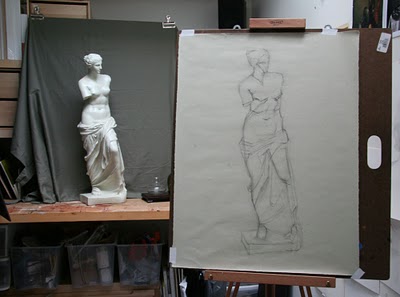
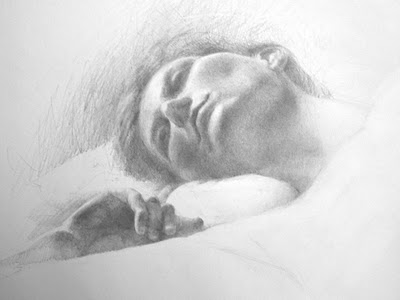
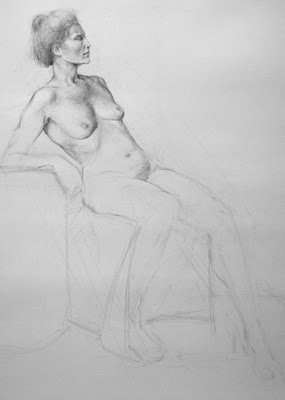
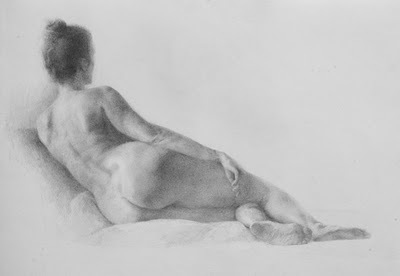
 pencil on paper, 18 x 24 inches
I have now worked on this drawing for 2 weeks, or 10 sessions. See the earlier version here.
I have one more week left, so I have to decide what to do. Do I continue to modify and refine this drawing, or do I start a new one?
I’ve gotten some great comments from my artists group (we are a group of artists of all kinds, writers, animators, singers, and filmmakers, and we meet monthly to share our latest endeavors over wine and snacks.) Of course they said complimentary things, too, but they very astutely pointed out the places I am struggling.
I need to resolve some issues with her right shoulder, her back, and refine the face & hair a bit more. They loved the elbow, which is one of the last things I worked on, so maybe I will try to apply what I learned there to the back, which I worked on very early in the drawing.
I am really enjoying my workshop with Ted Seth Jacobs, he is teaching me new ways to understand what I am looking at. The elbow in the the above drawing is I think most evident of what I am learning.
Paris, 15 years later
I am very excited to learn that I have been accepted to a figure drawing program in Paris for three weeks in April 08. The course is taught by former students of Ted’s who live and teach in France, their school is Studio Escalier. I studied at Parsons Paris for 6 months in college, back in 1993, so I am looking forward to visiting Paris as an art student once again, 15 years after the first time.
Notes from TSJ
I have transcribed some more of my notes from TSJ’s teachings. These are some of his overall themes, the ideas he repeats no matter what specifics he is showing us:
“I am not your teacher: nature is your teacher. But you have to have knowledge of the principles of form to understand what nature is showing you. These principles are helpful only as far as they help us see nature. If nature disagrees with a principle, nature is right, the principle is wrong. Nature is our teacher always.”
— Ted Seth Jacobs
Contour
- Contour is not flat, it is moving in 3 dimensions, back and forward
- Every contour on the body is held in a balance of tension between opposing forces.
- Every change in the contour is a result of 3-dimensional form
Light and shadow
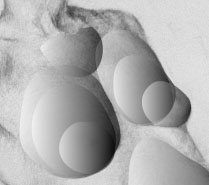
- Everything is divided into light and shadow. Always know whether you are working in the shadow or in the light. There is no such thing as “halftone”. There is only:
Light light
Dark light
Light shadow
Dark shadow
Accent (the darkest dark)
See the model as a flat ribbon of light
- Squint your eyes to simplify the lights and darks
- Don’t worry about highlights, pay attention to the largest masses
Ask yourself:
- Which end is closer to the light source?
- What is the tilt of the ribbon to the light?
- What is the lightest part of the pose?
Model the smaller forms in harmony with the larger value relationships.
Think about the three dimensional forms, not just a two dimensional pattern of lights and darks.
The edge of the shadow (also called the terminator, or core shadow) is not an impenetrable wall, there are forms criss-crossing through it
[UPDATE 12/2013 - Due to widespread misunderstanding of the term Terminator, I feel it’s important to revise my notes here and state clearly that the Terminator is NOT the same as a core shadow. It’s not even the “edge of shadow”. It’s the ending of the light, at the point where the form turns away from the primary light source. Ted never called it a Core Shadow, that was my misunderstanding 6 years ago when I took these notes. -SJV]
Shape the light to describe the form;
See what end is wider, which end is narrower; it’s often a “fan” shape, edges are never parallel
Form principles
- Even a concave shape is made up of tiny convex forms
- Each shape is a wedge that interlocks with other wedge shapes
- Find the specialness of each shape
- Make a portrait of each shape
We are not copying: copying is trying to capture what you see without understanding what you are looking at.
We are not representing reality; we are suggesting reality.
 Sunday, February 24, 2008 at 8:00PM
 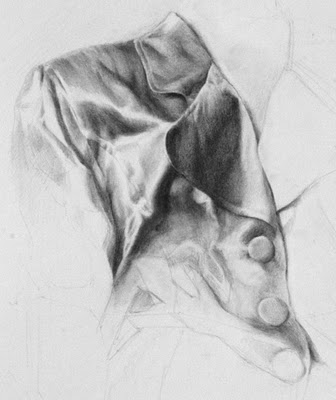 Drapery Study I
 Drapery Study II